Wednesday, October 30, 2013

Google barge in Portland, Maine adds to intrigue

Security, shell corporations, and tarps. Google has shrouded their San Francisco barge in mystery, and it’s only making the curiosity worse. Now there is news of a second barge, this time on the other side of the country in Portland, Maine. Just like the first, we have no idea what it’s for. Unlike the first, some have gone right up to it and taken photos… even looked inside.
Google barge

The “other” barge — four containers tall, four containers wide, and four containers long — was built in Connecticut and tugged to Portland. The containers are welded together, and interior walls have been removed to create larger rooms within the structure. The upper-tier levels have doors on either end of the structure, leading us to believe it needs to be manned, and won’t be a ghosted data center.
The information on the barge itself suggests it belongs to the same “shell” company that was responsible for the first structure in San Francisco, By and Large LLC. This also comes with news that Google coerced at least one Coast Guard employee to sign a non-disclosure agreement regarding the structure(s). The west coast barge is tightly controlled, and chains block anyone from getting near the dock near it. It’s often covered in tarps, and those who have been found poking around are sometimes watched by “Security” personnel.
In Portland, the Press Herald reports that a company named Cianbro Corp. is installing “undisclosed technology equipment” within the structure. Workers aren’t being told what the barge is meant for, or who owns it. Oddly enough, By and Large owns four of these barges, and all seem to follow a binary code for numbering them. We know that San Francisco has the first and second, with Portland having the third. Now the question is where the fourth is.

Barnes & Noble launches new Nook Glowlight

Barnes & Noble has launched an updated version of the Nook Glowlight e-reader. Aimed to directly compete with Amazon’s Kindle Paperwhite, the new Nook Glowlight is a notable improvement over its predecessor in almost every way imaginable.

For starters, the updated Nook Glowlight is lighter, tipping the scales at just 175 grams – in comparison, the Kindle Paperwhite weighs 213 grams. B&N has also managed to get rid of the annoying screen flashes that trouble other eBook readers..
The screen now packs 62% more pixels than the previous Nook Glowlight, according to Barnes & Noble. The eBook reader also features a new white color as well. On the software end the Glowlight got improved recommendation system, which now features insights from booksellers that should help you discover new content.
The new Nook Glowlight retails for $119 with its software free of ads. On paper at least, it’s well worth the $20 extra over the older model

Google Nexus 5 aces BaseMark X gaming benchmark

If all the rumors and teasers are to be trusted, Google will be announcing the LG-made Nexus 5 this Friday. The flagship has leaked numerous times revealing all there is to know about its design, specs and even pricing.
We've already seen official pictures of the Nexus 5 and we know it will come with a 4.95" 1080p IPS display and Snapdragon 800 chipset. What we didn't know is how the Nexus 5 will be performing on benchmarks with its new Android 4.4 KitKat, previously rumored as Key Lime Pie.
Well, it seems nobody is trying to keep the gadget under wraps anymore. Someone subjected the Nexus 5 to the BaseMark X test and the results came out very promising.
click image to enlarge

LG Nexus 5 scores compared to LG G2 and LG Nexus 4
BaseMark X is a cross-platform benchmark, which aims to test how good a device is for gaming. As it turns out the LG Nexus 5 scores 8% higher than its LG G2 sibling running on pretty much the same internals but with Android 4.2.2 in charge of operations. The Nexus 5 is also twice as fast as its Nexus 4 predecessor, but that is to be expected.
In fact, the Nexus 5 ranked as the second best gaming device in Rightware's database, only beaten by the iPhone 5s (which only has about a third of its resolution).
Anyway, it seems the new Android version and Google's own optimizations matter and the Nexus 5 may have an edge over its competitors unit they get their own Android 4.4 updates.

ZTE unveils a trio of Blade Q smartphones

ZTE has announced three affordable smartphones for the European market, which it hopes will help it grow its market share on the Old Continent.
The three new additions to the ZTE lineup are the 4.0" WVGA Blade Q Mini, the 4.5" FWVGA Blade Q and the 5.0" FWVGA Blade Q Maxi.

All three phones share similar internals. They are all powered by the MT6572 chipset with a dual-core 1.3GHz Cortex-A7 processor, Mali-400 graphics and 1GB of RAM. The trio also comes with 5MP rear cameras capable of 720p video recording, VGA front snappers, 4GB expandable internal storage, and Android 4.2 Jelly Bean in charge of operations.

ZTE Blade Q Mini • ZTE Blade Q • ZTE Blade Q Maxi
The connectivity options for Blade Q Mini, Blade Q and Blade Q Maxi are also identical - you get 3G with HSPA support, Bluetooth 4.0, Wi-Fi b/g/n, GPS and FM radio.
ZTE Blade Q Mini, being the smallest of the trio, has a 4.0" TFT display with 480x800px resolution. It comes with the smallest battery too - a 1500 mAh unit.
The ZTE Blade Q has a 4.5" TFT screen with 480x854px resolution and 1,800 mAh battery.
Finally, the ZTE Blade Q Maxi packs a 5.0" TFT display with 480x854px resolution and has the biggest 2,000 mAh battery inside.
The pricing and availability of ZTE Blade Q Mini, Blade Q and Blade Q Maxi is yet to be detailed

Lenovo Yoga Tablet 8 and Yoga Tablet 10 reimagine slate design

After Lenovo’s Yoga line-up of ultrabooks turned out to be quite a success, the company has decided to take a stab at making a Yoga tablet. Meet the Lenovo Yoga Tablet 8 and Yoga Tablet 10.

The members of the Yoga Tablet family feature a prominent circular bulge at the top, which holds a few tricks up its sleeve and allows the slate to stand in three different modes.
Lenovo calls them Hold, Tilt and Stand modes. Because of the aforementioned curve, holding the Yoga Tablet in portrait mode looks quite comfortable. The bulge also has a hidden kickstand that you pull out to make the tilt angle higher – that’s Tilt mode.
Finally, the Stand mode allows you to put the tablet sitting on a flat surface in portrait mode. The good news in the design department continue with the dual front-facint Dolby-certified speakers. Check out the photos Lenovo has provided below.

Lenovo Yoga Tablet Multimode photos
The two Yoga Tablet family members aren’t quite as spectacular on the inside, though. Both the Yoga Tablet 8 and Yoga Tablet 10 rely on a MediaTek 8125 SoC with a 1.2 quad-core Cortex A7 CPU and 1GB of RAM. The resolution of the two screens is 1280×800 pixels.
Internal storage is 16GB, but is expandable thanks to the microSD card slot. At the back, there’s a 5MP camera, while under the back cover sits either a 6,000mAh or a 9,000mAh for the 8-inch and 10-inch models, respectively. Lenovo says that both models are capable of going on for about 18 hours on a charge, which sounds really impressive.

Qualcomm updates its Snapdragon BatteryGuru app to version 2.0

Qualcomm has updated its BatteryGuru app that is designed exclusively for Snapdragon-powered smartphones. The chip maker’s native app enhances the battery performance, without damaging the overall experience with its optimizations.

The newest version of the BatteryGuru now comes with the improved battery management and the version 2.0 brings the all new intelligent charging recommendations.
Snapdragon BatteryGuru’s newest feature does not require any manual configurations, as the app itself learns how you use your smartphone and adjusts its settings to match your habits and preferences. However, the app requires a few days to learn about your usage pattern, before it’s all ready to go.
The latest version of the app will also now notify you when your Snapdragon powered smartphones runs out of battery juice before its usual charge time. Lastly, BatteryGuru now shows you the remaining battery percentage in the notification bar.
If you own a Snapdragon powered smartphone, you can download the latest version of the BatteryGuru app from the Google Play Store.

Intel's holdout against making ARM chips comes to an end

Unable to break through with its own mobile Atom chipset, it seems that Intel finally raised the white flag and has decided to begin manufacturing 64-bit ARM chips of its own
The ARM architecture's supremacy in the mobile market has been a result of the varied and competitive core licensing terms provided by ARM Holdings. This has allowed a variety of manufacturers - including Samsung, Apple, Nvidia and many more - to use ARM's core designs to create integrated SoC's of their own. In 2010 alone, an incredible 95% of smartphones shipped with ARM-based CPU's.
It was obviously in Intel's best interest to stop resisting the adaptation of ARM in the mobile realm, and its decision to enter into the fray against other semiconductor foundries (most notably Samsung and TSMC) brings up some interesting permutations.
First, will Intel's historic rival chipset manufacturers like Nvidia and Qualcomm be willing to do business with it over rival foundries? Second, what sort of advantages will Intel's 64-bit architecture offer?
This also opens up some interesting possibilities for Apple, who would love to be able to break ties with Samsung as the primary supplier of the ARM-based Ax SoC found in its iPhone smartphones and Apple tablets (including the upcoming A8 chip). It's a process that's been hinted at in the past, and estimated to take as long as a year and a half and cost Apple between $1 - 3 billion.
Intel's potential ability to make high quality 64-bit ARM CPU's may be enough to entice Apple into taking the plunge, and perhaps even get an exclusivity agreement in the meantime.

iPad Air benchmarks show 80 percent speed bump over iPad 4

The new iPad comes close to doubling the performance of its predecessor, according to Primate Labs

The iPad Air is 80 percent faster than the fourth-generation iPad, say new benchmark tests.
Running the new iPad through the paces via Geekbench 3 tests, Primate Labs found that the tablet comes close to reaching Apple's promise of doubling the speed of the iPad 4.
The iPad Air is powered by an A7 processor, just like the iPhone 5S. But the new iPad runs at 1.4GHz -- which is 100MHz faster than the 5S, Primate Labs founder John Poole said on Wednesday. He said he's not sure whether the iPad Air's processor is faster due to a larger battery (which offers more power), a larger chassis (which offers better cooling), or a combination of the two. But he does expect the iPad Mini's A7 processor to also clock in at 1.4GHz.
The new Air is also five times faster than the iPad 2, leading Poole to question why Apple is still selling the second-generation model, especially at $399, just $100 less than the starting price for the iPad Air.
He said that, from a performance standpoint, the iPad Air is a great upgrade to the iPad 4.
"With most recent Mac updates showing only modest performance improvements, it's exciting to see iOS devices do the opposite, with substantial improvements between generations," he said. "I wonder how much longer Apple can keep this up?"
The iPad Air is due to hit stores on Friday.

Sony Xperia L now getting Android 4.2.2

Sony has started seeding Android 4.2.2 Jelly Bean for the Xperia L smartphone. The update is available through the PC Companion and weighs about 700MB.
In addition to bringing your Android version to 4.2.2, the update packs several tweaks to the home-baked launcher. Those include a new homescreen, improved search and app sorting, updated media apps (Walkman, Album and Movies), easier Small Apps and two new camera features - Burst mode and Auto Scene Recognition.
The guys over XperiaGuide have built a rather detailed changelog. Here it is:

  • New homescreen UI, you can add up to 7 window panes now.
  • Add more widgets in homescreen and lockscreen.
  • Bug fixes and performance enhancements.
  • Superior auto mode (auto scene recognition) and Burst Mode feature added in Camera interface.
  • Better photo quality.
  • Updated Sony Media apps.
  • Small apps accessible from homescreen.
  • Improved search and app sorting now.
  • New Keyboard added.
  • Transparent dock at the bottom part on homescreen.
  • False memory notification bug is rectified.
  • Day Dream feature added in display settings.
So, if you own a Sony Xperia L, you should keep an eye on your notification area. The update is either available or just around the corner. Given, Sony's recent track record it shouldn't take more than a few weeks for the update to reach every Xperia L unit globally.
Thank you, Anurag, for the tip!

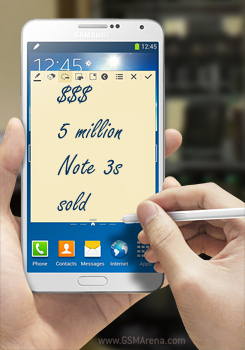
5 million Samsung Galaxy Note 3s sold in the first month

Analysts expect the Samsung Galaxy Note 3 to take up the slack now that the Galaxy S4 has passed 40 million sales and demand is weakening. According to Korean publication Hankooki (quoting the president of Samsung Mobile), the Note 3 phablet is off to a good start, having sold 5 million units in one month.
For comparison, the original Galaxy Note took 5 months to just ship 5 million units (not the same as sales). Of course, that was quite an achievement, too, given that back then phablets were an unproven concept.
The successor, the Galaxy Note II, sold 3 million units in its first month of availability and took another month to make it to the 5 million mark. Combined, Note and Note II have sold over 38 million units to date.
The Samsung Galaxy S4 sold 10 million units in the first month, which makes the Note 3's sale numbers all the more impressive – the S4 has a much wider target audience as phablets are still somewhat of a niche market.

Hangout to get update soon

As for Hangouts, the Android app now supports sharing your location instantly. It also supports SMS, so you can send and receive SMS through the Hangouts app itself, something we had heard was coming (the Messaging app would probably be retired in Android 4.4 now). Lastly, Hangouts also shows in-line animated GIFs.
Another addition is the ability to schedule Hangouts on the Air and to promote them with a dedicated watch page. You can also moderate the comments later when you’re live.
Lastly, the video calls are now fullscreen on mobile and desktop and it fixes and enhances the webcam lighting automatically.
The new Hangouts app would roll out in a few days and the On the Air improvements over the next few weeks.

Google+ gets a ton of new features along with Hangouts

At yesterday’s Google event, the company announced a slew of new features for their Google+ social networking service, along with the Hangouts messaging service.
Google+ already had a pretty impressive photo sharing experience that is way ahead of what other services such as Facebook offer but now Google has made it even better. In the new update, the service automatically scans your photos and sorts them by categories such as sunsets, snow, etc. by identifying over a thousand objects within the images to make searching for your photos easier.
The Auto Enhance feature automatically adjusts parameters to improve your image but you can also turn the level of adjustment up or down or choose not to apply it to an entire album if you’ve already edited the images before uploading.
The iOS version of the Google+ app will now get background uploading and syncing of photos to Google+ in full size similar to the Android version of the app. Google has also updated the Snapseed mobile app to add the HDR Scape filter.
There is also a new Auto Awesome feature. It has three techniques: Action, where it takes a bunch of burst shots from your library, combines them and creates a strobe-effect photograph. Eraser takes multiple images and scans for unwanted people in the frame and removes them. Lastly, Movie mode takes your photos and videos and combines them into a short movie with transition effects and soundtrack, which you can share as is or edit it later. Best of all, all these features work automatically without user intervention.
All these features will be available this week.
.

NVIDIA Shield gets a major update

NVIDIA’s Android-based handheld gaming console Shield has received a massive update that brings with it several important new features. The first one is the update to Android 4.3 from the 4.2 on the previous build. Android 4.3, as you may know, brings things such as Bluetooth Smart support, improved text input and OpenGL ES 3.0, among other things (although Tegra 4 in the Shield doesn’t actually support OpenGL ES 3.0).


NVIDIA has also updated the game streaming support on the Shield. Now called GameStream, it lets you stream from 109 titles (at the time of writing) from your PC running an NVIDIA Kepler-based GPU to your Shield. You can also connect your Shield to a TV and play the Shield games on the big screen in Full HD.
There is also a new gamepad mapper feature that lets you existing Android games without controller support to be mapped to the physical controller on the Shield. You map the keys on the screen to the buttons and then play the game using the buttons.
NVIDIA is also selling some bundles, where you can get a GeForce graphics card for your PC, a bunch of games and $100 off on the price of the Steam. So if you’re hunting for a graphics card for your PC this holiday season, you might want to consider that offer.

Apple admits a battery issue in a small number of iPhone 5s units


Earlier this month while going through our battery test of the iPhone 5s, we noted that on some occasions, the smartphone suffered from quick battery drain. Today, in a statement to The New York Times, Apple has acknowledged that a small number of iPhone 5s devices are indeed affected by such an issue.http://www.imore.com/sites/imore.com/files/styles/large/public/field/image/2013/09/grey_iphone5s.png?itok=4X9-hfCB    
According to spokesperson from Apple, a manufacturing issue sits at the heart of the problem. It has affected a “very limited number” (Apple has implied to The New York Times that there are a few thousand devices affected) of iPhone 5s devices and has caused their battery to take longer to charge, or have reduced endurance.
Apple has begun reaching out to users whose phones were affected. They will be given a replacement device.
source


iPhone 6 5-inch screen said to be done deal, due September 2014

iPhone 6 5-inch screen said to be done deal, due September 2014

A Japanese magazine claimed recently that the next Apple phone will feature a 5-inch screen and launch in September 2014.
That's right! The iPhone 5S and iPhone 5C are barely out, and the iPhone 6 hype train has already left the station.
The magazine is Mac Fan, with a report of the article coming from a Japanese website, Macotakara, today.
The 5-inch iPhone 6 rumor is just one of many, but it builds on previous reports that Apple is experimenting with different display sizes.

Choo choo

Those reports said that the new iPhone could go as big as six inches, but Mac Life claimed that the iPhone 6's screen size is now set in stone at 5 inches.
That's still up from the current iPhones' 4-inch displays.
The new 5-inch iPhone 6 display will be a full HD 1080p Retina screen, allegedly.
It's unclear where the magazine that issued the original report got its information, but this claim seems as likely as any other we're hearing about the iPhone 6.
Other iPhone 6 rumors have claimed that the next iPhone will feature NFC, wireless charging, and other new features

Google gives a first look at the next-gen Glass — including its nifty new earbud


Google gives a first look at the next-gen Glass — including its nifty new earbud
A day after Google teased a Glass hardware upgrade, the company is showing it off.
The updated Glass, which you can see in the photo above, looks just like its predecessor — with one main exception. As the photo shows, the Glass refresh comes with the addition of a mono ear piece, which joins the bone conduction tech found in the first generation Glass.
What Google didn’t show, however, was how the new Glass hardware will work with prescription frames though the company did link to an image of an early Glass prototype to show what it should look like.
Generally, there doesn’t seem to be too many cosmetic changes with the Glass hardware refresh though we’ll have to wait until Google is done teasing it before we can say for sure.