Tuesday, October 29, 2013

Motorola aims for do-it-yourself smartphones

(Reuters) - Motorola wants to let consumers design their own smarpthones.
The Google-owned manufacturer has launched Project Ara to create a free, open and standardized platform to let people pick and choose the components they want in their phones, Motorola said in a blogpost this week.
The goal is to create a standard endoskeleton, or frame, that can hold different modules, like extra-powerful processors, additional batteries or memory chips for storing more music, all based on the customer's preferences.
"Our goal is to drive a more thoughtful, expressive, and open relationship between users, developers, and their phones. To give you the power to decide what your phone does, how it looks, where and what it's made of, how much it costs, and how long you'll keep it," Motorola said.
Motorola's vision of do-it-yourself smartphones builds on parent company Google's success with its widely used Android smartphone platform, which it offers for free and allows manufacturers to customize. Android also gives people more leeway to tweak the features on their smartphones than Apple's iOS platform offers to iPhone users.
Motorola said it has been working on Project Ara for over a year and that it recently teamed up with Phonebloks, an open source project that has also been working on creating modular smartphone components that can be easily replaced.
The announcement of Ara follows Motorola's launch earlier this year of the Moto X smartphone, which lets customers choose the colors of the front and back panels and buttons.
On its website, Phonebloks envisions an online store letting consumers read reviews of smartphone components, shop for new and used parts, and order custom-designed handsets.
Project Ara is also a bit of a throwback to the 1980s and 1990s, when many technology-handy consumers assembled their own desktop PCs using hard drives, power supplies, CPUs and other custom-picked components.
That became less common when laptops, which are more difficult to customize, became widely used, but computer components are still made at standard sizes that can be slotted into most PCs.
Motorola said it will work on the project openly and create experimental modules. It plans to invite developers and recruit "Ara scouts" to help research and shape the project

Google’s Android smartwatch ‘ready within months,’ will feature Google No

Google is close to finishing the development of its first smartwatch — so close that the device could be “ready within months,” a source tells the Wall Street Journal.
The cogle Now will likely be its trump card — it’s a feature that’s grown immensely useful over the past few years, and it’s prominent on Google Glass and the Moto X. At this point, we can think of Google Now as the true Google homepage of the future, one that delivers information to you automatically, answers your questions, and yes, handles your web searches.
It makes sense for Now to play a prominent role in all of Google’s upcoming devices, especially its wearable gadgets. Google Now could also make the company’s smartwatch immensely more useful than Samsung’s Galaxy Gear by letting you tap into the full power of Google with voice commands. Even though the Gear can tell time, take pictures and short video, and run a few apps, none of its functionality is compelling enough to warrant its $300 price.mpany is reportedly in talks with Asian manufacturers about mass producing the smartwatch, and it’s currently working hard to reduce its battery consumption, other sources say. They also note that the smartwatch will sport Google Now, the intelligent virtual assistant that can fetch information for you even before you ask for it.
With Samsung’s disappointing Galaxy Gear on the market (and failing spectacularly), Google has a chance to swoop in and wow the tech world with a truly useful smartwatch.
Goo

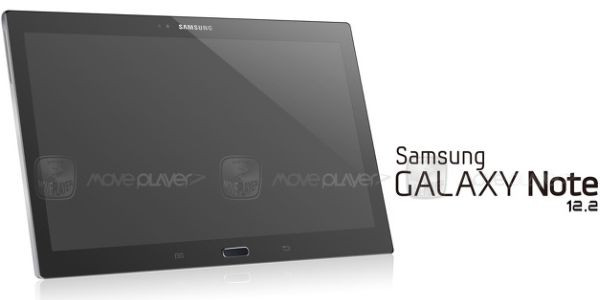
Verizon-bound Samsung Galaxy Note 12.2 gets benchmarked

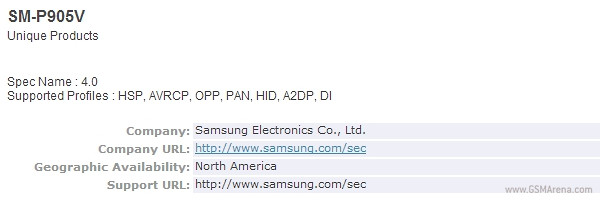
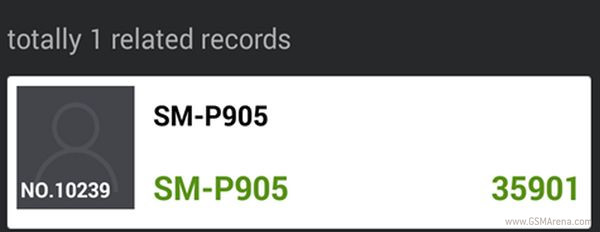
The upcoming Samsung Galaxy Note 12.2 has been spotted making its way through another Bluetooth SIG certification, and was even glimpsed in AnTuTu benchmark records
We first got a peek of the expected Galaxy Note 12.2 device back in early September. Back then all we knew was that there was an upcoming 12.2-inch slate from Samsung set to sport an Exynos 5 Octa chipset with a 2560 x 1600 pixel display.

Although it was apparently still too early back then for an official announcement at IFA, things have progressed quickly. The Note 12.2's model number now contains a V suffix (as in SM-P905V), which, according to numerous sources, stands for Verizon. If that's anything to go by, then the 12-inch tablet should be available with LTE support as well
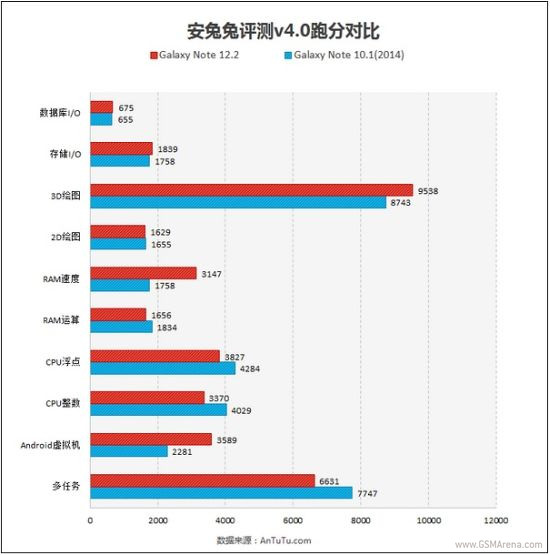
The AnTuTu benchmark tells a slightly different story than what was initially assumed about the Galaxy Note 12.2. The SM-P905 device featured in its database sports a Snapdragon 800 CPU rather than an Exynos 5 Octa. The folks at AnTuTu even compared it to a Galaxy Note 10.1 (2014 Edition), which sports the Exynos 5420 chipset
The Note 12.2 is able to outperform the Note 10.1 when it comes to the Android virtual machine, RAM speed, and 3D graphics, while the 10.1 does better in RAM processing, and CPU integer and floating point operations. Still, the Galaxy Note 12.2 achieves an overall score of 35901, which beats out our own score of 33198 for the Note 10.1 (2014).
While the results are higher, they're only to such a degree as the typical generational upgrade that we tend see as chipsets mature. Keep in mind that the aforementioned Verizon variant may run on an entirely different chipset, perhaps even the "true" octa-core variant of Samsung's Exynos 5 chip that will be able to run all 8 of its cores simultaneously.


Google smartwatch to enter mass production this year

Google’s alleged smartwatch is in the final stages of its development and the search giant is said to be in talks with Asian hardware suppliers to begin the mass production of the hotly anticipated accessory.

According to a report from WSJ, the Google smartwatch will enter mass production by the end of the year. Google is also said to be working around the major concerns with the smartwatch – the battery life and it’s every day utility. The internet giant has reportedly found a way out to enhance the battery performance and deliver long hours of usage on a single charge. Just how long is yet to be seen, of course.
If the rumors are to be trusted, the upcoming smartwatch will be integrated with the popular Google Now platform and feature its always on voice commands (similar to the feature found on Moto X). If true, that would certainly help the Google wearable stand-out in the upcoming crowd of smartwatches.
However, let’s keep in mind that these are just speculations and there is no official word from Google for now. So, take it all with a pinch of salt and keep your hopes low.

Samsung’s curved display significantly boosts usability, study finds

Recently Samsung announced the Galaxy Round smartphone with a 5.7″ 1080p Super Flexible AMOLED display. Lots of people thought the curved display is just a gimmick or, even worse, an unnecessary feature designed to extract more of your hard-earned cash

The researchers from DisplayMate Technologies don’t seem to share that view and found the curved screen quite useful. Their study found that the curved display reduces reflectiveness, which in turn imrpoves contrast and sunlight legibility.
Raymond Soneira, the president of DisplayMate Technologies, says the Galaxy Round’s display is not “a marketing gimmick as has been widely reported”. He wrote an extensive article explaining why the curved AMOLED display might be the next big thing to happen to mobile screens.
The major advantages of the curved display are improved privacy and reduced reflectiveness because of the curvature. That improves contrast when there are strong light sources around you and makes the screen more legible. Furthermore the panel had reduced glossiness because Samsung had to use curved plastic instead of glass to cover the new display.
So, the long story short – Samsung’s new display is cool and while the Galaxy Round will only hit Korea (and even there it will have very limited availability), its successors might make a huge difference to the overall user experience. By the way, the Galaxy Round has already met its first competitor – the LG G Flex – so the curved screen war has already begun.

Google Glass 2 Release Date, Features and Specs: Device Gets an Upgrade; Will Fit Prescription Glasses

Google announced on Monday that the company is ready to engage in the phase two of the Google Glass beta program. It is a wearable computer with an optimal head-mounted display offered by Google under the company's Project Class research and development. The company seeks to produce a mass-market ubiquitous computer wherein users can have access to information through a smartphone-like hands-free format. Users can also communicate with the internet just by using their natural voice when wearing Google Glass. It is truly a piece of breakthrough innovation that a wider majority still has to caught up with. Still, thousands of people have already been testing out the first generation Google Glass earlier this year. The software is also being updated monthly.
According to Phone Arena, Google is now ready to take this project up a notch. Google announced that it is now prepared to upgrade the hardware as well as offer a one-time swap of the first Google Glass for this second generation Google Glass in November.
Google Glass fans will be more in love with the second generation Google Glass. The new hardware can work with future lines of shades as well as prescription frames. The new hardware also offers a mono earbud. The battery size and camera sensor may also be improved. However, what is really making the fans jump up and down is the fact that Google Glass may now work well with prescription glasses.
 This is a huge improvement. One of the main contentions with the first generation of Google Glass is that those with eyeglasses cannot test the device or wear it altogether. Either they have to change to contacts or they will not have the opportunity to use Google Glasses. With the second generation Google glass, people with prescription glasses may have the opportunity to experience this already. Those who have the Google Glass first generation can also swap it for a new one by just signing up and completing the swap once the program runs.

Samsung Galaxy Gear gets full notification support with a cool app

Samsung Galaxy Gear is surely a cool gadget, but it comes with lots of annoying limitations. Samsung is promising it will explore further the Galaxy Gear capabilities and will deliver more features later on.
Meanwhile an XDA Developers member has made a very useful app that will show full notifications on your Galaxy Gear for all apps, not just messages and emails as it is by default.
It was indeed frustrating that such a capable and expensive gadget as the Gear is capable of displaying complete notifications only for the SMS messages and emails, while you get only header-like notifications for all other apps.
Luckily the XDA user Sepiroth887 has created the AllTheNotifications (ATN) Manager that allows you to choose which apps to display full notifications on your Gear. It is very easy to setup and you need just to choose the desired apps from a list.
If you’ve used Pebble, you’ll know Pebble had a similar problem (being not compatible with lots of apps such as Viber, Skype, Facebook, etc.) that was later fixed with the Pebble Notifier app.
So, if you own a Gear and a compatible Galaxy device (Android 4.3, latest TouchWiz), head over the source link below, get the app and thank Sepiroth887. Be sure to follow the instructions on how to install it. The app is still in its infancy and has some issues, such as it will display notifications even when you are using your Galaxy, but they will be probably resolved soon.
Source

BBM scores 20 million new subscibers in a week

In a world filled with free communication apps like Viber, WhatsApp, Facebook (and Messenger), Google Hangouts and iMessage, BlackBerry Messenger was able to carve a serious user base for itself it just a week.
Since the BBM rollout on iOS and Android resumed 7 days ago, BBM has gathered 20 million new users.
That’s active users and not just downloads and is a serious step up from the 5 million in the opening 8 hours of up time.
BlackBerry has also announced that it has removed the waiting in line on iOS and Android and users can now activate BBM right away.
BBM is regarded as a top tier communication tool. It features a more secure way of sharing your information (not everyone that has your mobile number can see your information), as well as delivered and read statuses.

BBM for android 2.3 or 2.3.6

This good new for those running a lover version of android below 4.0
currently there two version and i don't know which one will be more steady for you but here the links try them both
bbm link  bbm2 link

Samsung Galaxy Note 3 gets a bug-squashing update

The Snapdragon 800-version of the Samsung Galaxy Note 3 is getting an over-the-air firmware update. It weighs 116MB and should be available to all SIM-free and unlocked N9005 models any moment now.
According to the official changelog the update brings stability improvements plus it turns off the re-activation lock, which requires you to input your Samsung account details after a factory reset of the phone.
Until today, this option was turned on by default and, while it added some extra security, it came as nasty surprise to those that didn't know it existed. If you want to reenable it, you should go to Settings -> General -> Security.
The new update also squashes many known bugs, including those related to the Pebble smartwatch accessory. The Samsung home-baked keyboard has been reskinned, too.
If you happen to have already received the update, drop us a line in the comments section, mentioning how you find your Galaxy Note 3 after it

Samsung now sells 1 million mobile devices per day

David Eun, executive vice president at Samsung, revealed today at Samsung's Developer Conference that Samsung sells some 1 million mobile devices every day. This includes smartphones, tablets, and anything that can be considered mobile
Eun's message to developers was that Samsung's next goal is getting them all to communicate with one another.
"We know many of these devices and screens are connected. This is largely due to the fact that some 40 percent of the population connects to the internet. We hope to build along with you one of the largest platforms in the world for content, services, apps and ads. We call this the connoted home, and the connected life."
Samsung has helped shape Android into the premiere platform for mobiles, and it's obvious it wants to extend this into other consumer applications as well. By putting out a million mobile devices daily, the Koreans certainly have a large client base at their fingertips to do just that.

Phonebloks is the modular phone concept you need but will probably never get

Most electronic devices are abandoned due to a fault that is usually the result of one component going bad. This results in a lot of electronic waste full of devices that are otherwise fully functional save for one or two failed components. So what if you had a phone where you could just replace one component if it goes bad? Or build a phone with just the components you want?
This is what the Phonebloks concept is all about. Conceptualized by Dave Hakkens, Phonebloks is a completely modular mobile phone, where every part such as the display, speaker, camera, battery, etc. are modules that plug into a board and you can remove and replace them as you desire.
This not just lets you replace one component easily if it goes bad but you can also customize it to your liking. So for example, you can build a phone with a bigger battery if you want, or if you’re into photography, you can choose a better camera module, or a bigger speaker module if you like playing your music loud.
To bring this concept to reality, Hakkens needs people to show interest in the concept by sharing it online to a point where companies take notice and would want to build this. This is where my ‘but will probably never get’ cynicism for the post title comes in.
Currently, phone manufacturers make a fortune selling you a new phone every year. Most of the devices we use today are designed to become obsolete in a year or two, sometimes sooner than that. Even if the hardware is fine, the software makes the experience unbearable after a while for seemingly no reason. This is called planned obsolescence and everyone does it these days. To expect these companies to give up this strategy, so that you can replace or upgrade individual parts instead of the entire phone and keep using the same phone forever, and make less money from you in the process is hilarious.
So while the concept is great and I’d love to see it become a reality, it’s obvious that’s never going to happen.

Motorola announces Ara, a new modular phone concept

We have seen the ambitions Phonebloks concept in the past. But while the idea was definitely amazing, it was hard not to get cynical about its success, considering it was just guy with an idea trying to get the attention of companies around the world to make it a reality.
But what if one of those companies decided to take the idea and do something about it? Presenting the Motorola Ara, a modular phone concept that might actually become real one day.
Just like with Phonebloks, the Ara will have removable modules that will let you replace or upgrade specific parts of the device. This makes repair and upgrading easy but also lets you customize the phone to your exact needs. You can choose only those modules that are important to you and skimp out on the others.
The Motorola Ara project has been in development for a year now, so it's not something Motorola put together when they saw the Phonebloks video. Motorola will also be working with the creator of the Phonebloks concept Dave Hakkens on the Ara project.

Motorola will soon be sending invites to developers to start working on modules for the Ara and an alpha version of a Module Developer's Kit will be released in winter.